

Women's and Gender Studies, BA
- The mission of WGST is to examine the complex interplay of power and difference across multiple intersecting categories, including gender, race, sexuality, class, age, ability, and nationality.
- As a WGST student, you’ll develop tools for addressing social inequities in everyday life.
- WGST is an interdisciplinary field that embraces humanities, arts, social science, and STEM fields. You’ll investigate the meanings of categorization and difference on local and global levels.
Your Degree Plan
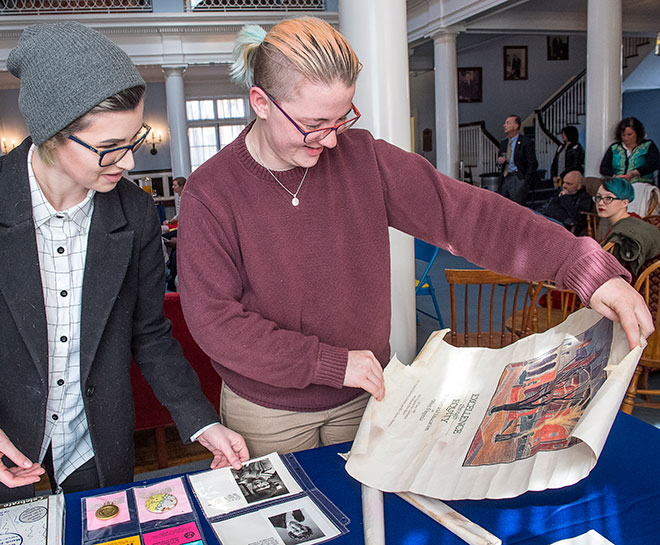
Through our interdisciplinary curriculum, you will learn to analyze inequities and differences while developing valuable real-world skills that will enable you to be an agent of change in your community and the world.
As a WGST major, you’re required to take a sequence of core courses. These courses provide the analytic framework for the study of women, gender, and sexuality that will inform all courses in the major.
Coursework
Introduction to Women’s and Gender Studies, Feminist Histories and Practices, Feminist Theories, Queer Theories, and Senior Capstone
Elective Courses
After completing some of the core coursework, you will take a number of elective courses from various disciplines. This flexibility lets you shape your curriculum to support your career and professional development goals. You’ll work closely with faculty advisers to select courses that balance breadth of knowledge with your specific interests.
You can find a list of electives in the undergraduate catalog. You may also petition for courses not listed in the catalog to count for the major.
Minor Field
You must complete a minor or second major. Our program’s interdisciplinary nature gives you the freedom to explore a secondary field of your choice. Popular pairings include Psychology, Biology, English, History, Sociology, Philosophy, Criminology, Forensics, and Native American Studies.
Women in Movies
WGST 150
Through viewing popular Hollywood films, we will analyze femininity across the life span. Critical thinking and cultural analysis will be practiced as we study heroines, working girls, motherhood, brides, cheerleaders, and old women on screen.
Women in Science
WGST 250
History of women in science and methods of gender analysis applied to issues facing women in science in the United States.
Women in Appalachia
WGST 225
Use variety of sources to explore how race, class, ethnicity, sex and gender impact lives of diverse Appalachian women, including portrayal of women, stereotypes, impact of stereotypes, and how women construct their own identities.
Women in International Development
WGST 345
Examines cultural diversities in the definition of women's roles and status; investigates women's access to education, health, income, credit and technology; and studies women's contributions in third world development.
Gender and Violence
WGST 340
Gender violence has implications for all members of society. This course will examine violence in the lives of women across the lifespan. Etiology, theories, effects, and prevention modalities will be evaluated.
Perspectives on Lesbian, Gay, Bisexual, Transgender, and Queer Studies
WGST 260
Overview of lesbian, gay, bisexual, transgender, and queer studies. Examines the construction of gender, biological sex, sexual orientation, and gender identity, expression and performance related to lesbian, gay, bisexual, transgender, queer, questioning, intersex, asexual, pansexual, and two-spirit identities. Also examines intersections with race, ethnicity, class, nation, culture, ability, and religion.
Sexuality in American Culture
WGST 448
Explores changes in sexuality in the United States from the 17th century to the present, examining social and cultural struggles and debates over the meaning of sexuality and sexual orientation in American society.
Sex and Science at the Movies
WGST 450
Explores how bodies, sexuality, and other gendered traits are used in films to demonstrate techno-science's societal impacts. Examines the relationship between media representations and techno-scientific practice.
Men and Masculinities
WGST 460
An advanced seminar in women's and gender studies that critically examines the concept of masculinity and its impact on men's and women's lives. Analyzes masculinities from cultural, historical, biological, philosophical, sociological, psychological, economic, and political perspectives.
Honors
Expand your curiosity and enhance your curriculum through the WVU Honors College. Two programs are offered: Honors Foundations and Honors in Action.
The WVU Difference
What sets this program apart?
- Our faculty have international and national reputations for their research and teaching.
- Our faculty are not only WGST experts in but are trained in a variety of fields including biology, geography, history, and English.
- You are never “just a number” in WGST! You’ll receive a hands-on education and develop close relationships with faculty and students.
- Our graduates work in a wide range of fields, from medicine to community organizing.
- We offer a wide range of scholarships and awards.
- You’ll have opportunities for internships, independent studies, travel courses, study abroad, service learning, and hands-on research with faculty.
- SpeakWrite Certified Major automatically fulfills the WVU General Education Foundations writing and communication skills requirement.
- Earn academic credit through Eberly internship courses.
- 500+ scholarships awarded annually by the Eberly College of Arts and Sciences.
- Academic Enrichment Program offers funding for activities that complement, extend, and enhance your academic experience.
Learn by Doing
Get involved outside the classroom.
Summer Undergraduate Research Experience (SURE)
An 8-week WVU summer program for students interested in graduate school and research/creative work in their discipline or a related discipline. Participants work under the direction of a WVU faculty research mentor and a graduate or post-doctoral mentor. Students interested in research careers are especially encouraged to apply.
Research Apprenticeship Program (RAP)
A two-semester WVU program for students with limited or no research experience. Students can earn course credit and use federal work-study funds for undergraduate research apprenticeships with WVU research faculty.
Undergraduate Teaching Assistants
Many of our students are offered the opportunity to serve as undergraduate teaching assistants in WGST courses. This unique opportunity provides hands-on experience in the classroom.
While each student’s experience as an undergraduate teaching assistant varies, TAs typically assist with grading and classroom management. The supervising faculty member will provide each TA with an experience tailored to their goals, strengths, and experience.
Students earn credit hours in WGST 491 for serving as an undergraduate teaching assistant. This course counts as an elective for WGST majors and minors.
View all of the student organizations you can join.
We strongly encourage WGST students to complete internships. Working closely with your adviser, we tailor the internship destination and experience to your unique goals and skills.
If you’re interested in pursuing careers in the non-profit sector, there are numerous opportunities to gain valuable experience at local and national organizations like the Morgantown Human Rights Commission, Planned Parenthood, Feminist Majority Foundation, Sexy Sex Ed, Appalachian Prison Book Project, The Stay Project, WVU Women’s Resource Center, and WVU LGBTQ+ Center, among others.
- Demonstrate understanding of key concepts of the interdisciplinary field of women's and gender studies, including how gender, sexuality, race, ethnicity, ability, and legal status shape experiences of individuals and interlocking systems of power from local to global scales.
- Use critical thinking skills and interdisciplinary feminist, gender or queer approaches to research, revising, and presenting knowledge.
- Employ interdisciplinary feminist, gender, or queer methodologies to problem solving evidenced through multiple modalities of communication.
- Apply feminist, gender, or queer theory, methods, and praxis to scholarship, activism, or public engagement. in the classroom, social institutions, the community or the workplace.
Careers and Outcomes
How does this degree prepare students for a career?
Gender, Culture, and Society
Career path: Social worker, counselor, educator, non-profit leader, national service
Suggested courses: Women in Movies; Feminist Histories and Practices; Women in Appalachia; Methods for Inclusive Research; Gender and Violence; Sexuality in American Culture Perspectives on Lesbian, Gay, Bisexual, Transgender and Queer Studies; Men and Masculinities; Teaching Practicum
Health and Medicine
Career path: Physician, nursing, healthcare administration, public health researcher, women’s health professions, LGBTQ+ health professions
Suggested courses: Women’s Health and Fitness; Women in Science; Gender and Violence; Sex and Science at the Movies; Perspectives on Lesbian, Gay, Bisexual, Transgender and Queer Studies; Methods for Inclusive Research
Law and Justice
Career path: Law school, lawyer, policing, public policy
Suggested courses: Feminist Histories and Practices; Perspectives on Lesbian, Gay, Bisexual, Transgender and Queer Studies; Gender and Violence; Methods for Inclusive Research; Women’s Movements Since 1960
Social Justice, Advocacy, and Community Organizing
Career path: Nonprofit leader, community organizer, political office, nonprofit sector, social services
Suggested courses: Feminist Histories and Practices; Women in Appalachia; Gender and Violence; Perspectives on Lesbian, Gay, Bisexual, Transgender and Queer Studies; Methods for Inclusive Research; Women in International Development; Men and Masculinities
Fields of study
Our students often go on to complete graduate programs in other fields at WVU including (but not limited to):
- History
- English
- Social work
- Sociology
- Medicine
- Education
- Public policy
- Psychology
WVU graduate certificate
While WVU does not have a stand-alone graduate program in WGST, we do have a graduate certificate.
This certificate program requires a student to be enrolled in a graduate program in any field at WVU. Students work closely with an adviser in WGST to tailor a minimum of 15 credit hours of courses relevant to women’s and gender studies.
Meet Your Community
The Women's and Gender Studies family will inspire you.
Cynthia Gorman

Professional Highlights
- Associate Professor
- Forthcoming chapter in 2025 on “Gender and Asylum” in The SAGE Encyclopedia of Refugee Studies (edited by Yến Lê Espiritu).
- Authored an article in 2024 titled "'All My Friends Here Are Ghosts:' Everyday geo-legalities in a rural poultry town” in the journal Social and Cultural Geography. The article explores the experiences of precariously documented people working in poultry processing plants.
- Certified mentor in Community-Based Participatory Research through the Knowledge for Change Consortium of the United Nations Educational, Scientific, and Cultural Organization (UNESCO).
- Recently served on the editorial board of the Annals of the Association of American Geographers.
- Received research funding from the National Geographic Society.
Kasi Jackson

Professional Highlights
- Professor of Women's and Gender Studies; Director, WVU ADVANCE Center
- Current research interests are using AI tools as collaborative research partners.
- Passionate about broadening participation in STEM fields.
- Explores how science and scientists are depicted in horror, fantasy, and science fiction media ("the lower budget and sillier the better").
- Has published work on what images of female scientists in ecodoom films can teach us about environmental movements
- "Come find me if you want to learn more — I love to chat with students! I especially enjoy working with students on study skills and time management techniques to help them build their confidence and maximize their potential."
Dr. Kelly L. Watson
Professional Highlights
- Director of Women's and Gender Studies and Service Associate Professor
- Authored Insatiable Appetites: Imperial Encounters with Cannibals in the North Atlantic World (New York University Press), 2015.
- Contributed a chapter, “Sex and Cannibalism: The Politics of Carnal Relations between Europeans and American ‘Anthropophagites’,” to the award-winning volume To Feast on Us as Their Prey: Cannibalism in the Early Modern Atlantic from the University of Arkansas Press.
- Published an essay, "'Ourselves Writ Savage:' Disease, Desire, and Colonialism in Kuru Country," in a special issue on "Disease and Exploration" for the journal Terrae Incognitae.
- Published an essay, "Mary Kittamaquund Brent, ‘The Pocahontas of Maryland:’ Sex, Marriage, and Diplomacy in the 17th century Chesapeake" in the journal of Early American Studies, 2021.
- Has presented research at numerous conferences in the U.S., UK, and Mexico.
- Distinguished Scholar Award, Avila University, 2017
- "My proudest professional accomplishment is watching so many of my students make a real difference in the world!"

"If I could do undergrad all over again, I would not change a thing. My experience in WGST has been so transformative and beneficial to my knowledge of the world and social justice issues I wish to combat. I encourage every single student I meet to take a WGST course for the topics and conversations you are exposed to."
Isabel Thubron (she/her)

"I am currently the operational designer of several dual admission partnerships across Virginia, serving predominately low-income, first-generation and minority-majority student populations. The programs foster greater access to higher education and actively reduce institutional and financial barriers to bachelor’s degree attainment. The foundation I received at WVU in feminist, anthropological and sociological theories continues to inform my daily praxis by using concepts including social location, intersectionality, power, privilege and oppression while working within one of the largest social institutions influencing equality and social change. The incredible faculty and valuable education I received nurtured my passion for understanding social issues and gave me the tools requisite to dedicate my career to educational equity."
Rita Alcala (Snyder Furr)
BS, Women's and Gender Studies; Anthropology and Sociology Concentration, 2010

"I am deaf with bilateral cochlear implants and have low vision. I am an advocate for family, friends, and myself — advocating for others and myself so we are heard and not pushed aside. I have participated in an internship with the Commonwealth of Pennsylvania working under the Substance Abuse and Mental Health Services Administration. I published a writing on my domestic and sexual violence experiences, raising awareness about domestic and sexual violence on local university campuses and to the general public. I currently work as a Photo License Technician for the Commonwealth of Pennsylvania. I am an advocate for my coworkers, customers, and myself. I was recently awarded for an outstanding achievement award by my employers.
Julie Goldberg
Women's and Gender Studies
"The Women's and Gender Studies program got me to this place because of the values I developed through my education at WVU. There are populations of people that deeply matter to me and always have but now because of my education, I have a way to connect gender studies and social work; such as how gender impacts mental health and well-being but also how gender plays an impactful role on people's everyday lives. One of the ethical principles of social work is social justice and that is exactly what WGST prepared me for — helping make the folks who are often overlooked and unheard heard."
Shaniyah Jasper (they/she)

"I started taking the Women's and Gender Studies courses to complete my credit hours to graduate. As I began to discover topics that interested me as a non-traditional student; I was learning more about myself at the same time. Prior to taking WGS courses I would not have described myself as a feminist, but I am and proud of who I am and what I stand for today. My education in WGS has helped me in my current position of managing the WVU Passport Acceptance Facility. For example, last year a faculty member brought their child in for a new passport they were changing the gender marker on the application. Sometime after the appointment, the faculty member made a special attempt to come by my office and thanked me for not being judgmental and understanding of the situation."
Becky McDaniel (she/her)
Communication Studies and Women's and Gender Studies, 2013

"I have spent most of my career in banking as a business credit analyst and was recently promoted to the role of Vice President and Senior Credit Product Team Lead for the state of PA at WesBanco. While WVU's College of Business and Economics taught me to read and understand financial statements, it was the Women's and Gender Studies program that trained me to think critically and defend my position. These skills have been essential in my career. The WGST program introduced me to queer and/or trans theorists, educators and artists, which allowed me to imagine a future for myself that I did not know was possible. To pass that gift along, I volunteer as a mentor with Big Brothers Big Sisters of Greater Pittsburgh in their Big Siblings program."
Reginald Yankie (he/him/his)
Women's and Gender Studies and Accounting, 2009
FAQs
Common questions and answers about Women's and Gender Studies.
- Admitted students may submit a Change of Major Request. This form is for prospective students only.
- Currently enrolled students must meet with their academic adviser.
- Please review the admissions requirements to ensure that you are eligible for the requested major. Requests will not be processed if ineligible.
Places and Spaces
See where you’ll study, research, and create.
LGBTQ+ Center
Women's Resource Center
Virtual Tour
It’s the next best thing to being here. Virtually tour our campus and residence halls.
Student Life
You'll experience epic traditions, quality academics, and a supportive community that feels like home.
Visit
See WVU in person and start imagining life as a Mountaineer.
Admission Requirements
To be admitted to the Women's and Gender Studies major, first-time freshmen must meet WVU's first-time freshman admission requirements. Interested in transferring? Review the transfer admission requirements.
Tuition and Aid
How much does Women's and Gender Studies at WVU cost? And how can you save?
Tuition and Fees
Estimated rates are available on our tuition website. Anyone who is not a current West Virginia resident, including international students, will be charged non-resident rates.
Ways to Save
Beyond scholarships, here are other ways to reduce your cost of attending WVU.
Financial Aid
The most important step toward funding your future with financial aid for the Women's and Gender Studies, BA is submitting the Free Application for Federal Student Aid, or FAFSA.
Start at Another WVU Campus
You can start your career with WVU at another campus and transfer to WVU Morgantown.
Transfer Articulation Agreements
To simplify the transfer process, we have formal agreements with certain institutions. These agreements outline the courses you should take to prepare for transferring to WVU.
Review the full list of transfer articulation agreements to see if your institution is listed.
Request Info
Want to know more about Women's and Gender Studies at WVU? Fill out our request form to receive more information.
Visit
Experiencing campus is the best way to see if WVU is the right fit. Choose from in-person and virtual options.