
Physics, BA/BS
With the appropriate electives, you can open doors to a significantly wider range of careers, including law, journalism, teaching, healthcare, administration, and business.
Both the BA and BS degrees also prepare you for academic and professional graduate programs.
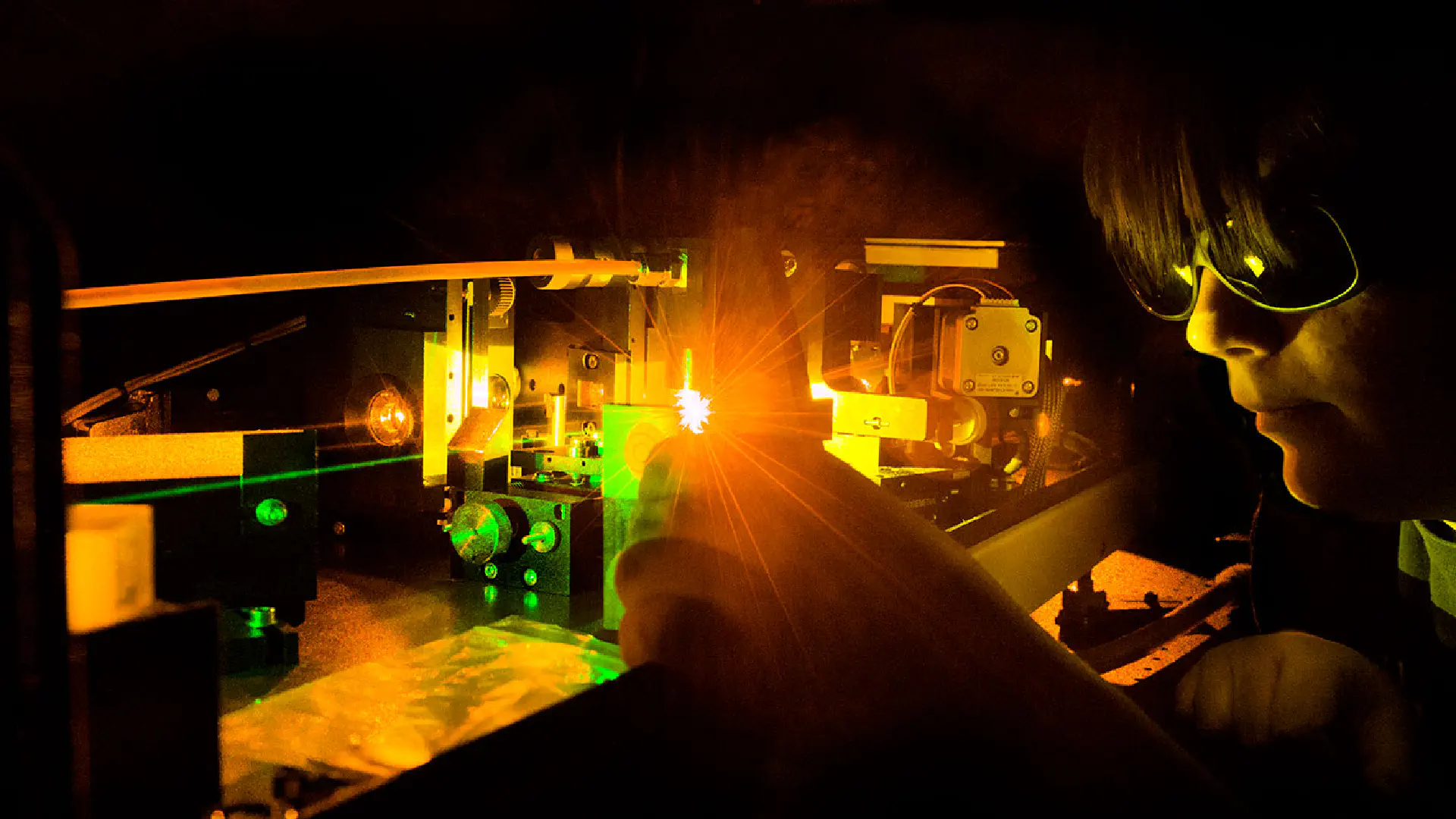
Our Physics and Astronomy faculty members are world-renowned leaders in their fields. From cutting-edge astrophysics, quantum materials, and laser experiments to space-based plasma physics experiments and theory, we offer unique learning experiences.
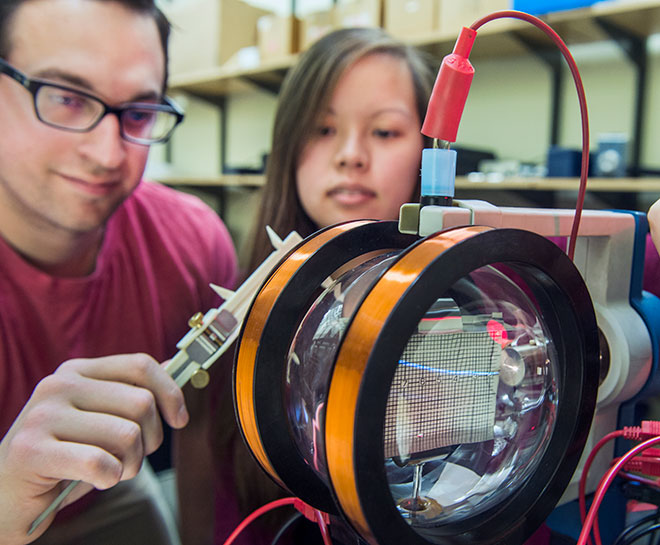
As a Physics student, you can begin hands-on research as early as your 1st semester. For example, through the RockSat program, a NASA-sponsored initiative, students design, build, and fly experiments into space.
Your Degree Plan
Astrophysics 1
ASTR 367
Physical description of the astronomical universe. Physical principles are used to explain the properties and evolution of stars. Physical properties and effects of the Milky Way's interstellar medium are examined.
General Relativity
ASTR 470
Innovative 'physics-first' introduction to Einstein's relativistic theory of gravity. Topics covered include special relativity, curved space time, spherical stars, gravitational collapse, black holes, gravitational waves and cosmology.
Introductory Modern Physics
PHYS 314
Topics of modern physics of interest to science majors and engineers; atomic and molecular structure and spectra, solid state and nuclear physics, relativity, and elementary particles.
Advanced Physics 1 Laboratory
PHYS 341L
Experiments in physics designed to complement theory courses, give experience in data taking and instrumentation, and learn methods of data evaluation and error analysis. This course focuses on learning foundational lab techniques using guided experiments.
Advanced Physics Laboratory 2
PHYS 342L
Experiments in physics designed to complement theory courses, give experience in data taking and instrumentation, and learn methods of data evaluation, error analysis, and documentation and reporting. Emphasis on developing independence in the physics laboratory.
Introduction to Quantum Computing
PHYS 351
Fundamental principles of quantum mechanics; state functions in position and momentum space, operators, Schrodinger's equation, applications to one-dimensional problems, approximation methods, the hydrogen atom, angular momentum and spin.
Introductory Quantum Mechanics
PHYS 451
Fundamental principles of quantum mechanics; tate functions in position and momentum space, operators, Schrodinger's equation, applications to one-dimensional problems, approximation methods, the hydrogen atom, angular momentum and spin.
Computational Physics
Medical Physics
Professional Preparation
Space Physics
Honors
Expand your curiosity and enhance your curriculum through the WVU Honors College. Two programs are offered: Honors Foundations and Honors in Action.
The WVU Difference
What sets this program apart?
- Hands-on participation in research at the undergraduate level and the ability to work with faculty members directly on experimental or theoretical studies, as early as your 1st semester.
- Physics majors have discovered entirely new objects in the universe. One of these, the first fast radio burst, led to the Shaw Prize in Astronomy in 2023.
- On-campus resources include 8 teaching labs; machine and electronics shops; a physics cleanroom; and facilities for high-performance computing, materials characterization, biological and health sciences, and computer science and electrical engineering.
- Students travel to domestic and international conferences, often with funding, and enjoy regional trips to places like Coopers Rock and Ohiopyle State Parks for department events.
- Earn academic credit through Eberly internship courses.
- 500+ scholarships awarded annually by the Eberly College of Arts and Sciences.
- Academic Enrichment Program offers funding for activities that complement, extend, and enhance your academic experience.
Learn by Doing
Get involved outside the classroom.
Research Groups in Physics and Astronomy
- Astronomy and Astrophysics: Focuses on gravitational waves, pulsars, black holes, fast radio bursts, star formation, galaxy evolution and formation, theoretical astrophysics and our Milky Way Galaxy.
- Condensed Matter Physics: Studies materials, their interfaces and interactions to lay foundations for new physics applications.
- Optical and Laser Physics: Uses light as a probe to learn about the microscopic electromagnetic behavior of novel materials and the thermodynamics of plasma.
- Physics Education Research: Analyzes physics courses at WVU to improve their effectiveness and inclusivity.
- Plasma and Space Physics: Examines plasma behavior to understand natural processes that occur in space plasmas and magnetically confined fusion plasmas.
Research Centers
- Center for Excellence in STEM Education: Advances STEM learning in West Virginia through innovative programs and partnerships, and through networking opportunities for students and educators.
- Center for Gravitational Waves and Cosmology: Studies astrophysical phenomena using electromagnetic and gravitational wave observatories.
- Center for KINETIC Plasma Physics: Solves complex problems in magnetized plasmas while promoting public education and outreach.
Partnerships and Service Opportunities
- Mountaineer Area Robotics: Partners with NASA, 4-H and the international FIRST robotics program to mentor middle and high school students in robotics.
- Pulsar Science Collaboratory: An NSF-ITEST funded project run by the National Radio Astronomy Observatory and WVU Physics and Astronomy faculty that’s allowed students to assist in the search for pulsars at the Green Bank Telescope since 2007.
- Green Bank Observatory Partnership: WVU students and faculty use the 100-m Green Bank Telescope for research projects.
- Science Public Outreach Team: Recruits and trains student ambassadors to deliver STEM presentations to K-12 students across West Virginia.
View all of the student organizations you can join.
Before graduating, all undergraduates in this major complete an academic project (or “capstone”) to demonstrate their research, communication and critical thinking skills. Projects have included:
- A fast radio burst in the direction of the Virgo Cluster by Ben Gregg
- A search for millisecond radio bursts with Messier 82 by Tate Hawkins
- Demonstration of confocal laser induced fluorescence at long focal lengths by Miquel Henriquez
- GBTrans: a commensal search for radio pulses with the Green Bank 20-m telescope by Olivia Young
- Measurements of the 5D◦4 −5P3 transition of singly ionized atomic iodine using intermodulated laser induced fluorescence by Matthew Lazo
- Timing a Double Neutron Star Binary by Gabriella Agazi
- Timing observations of three Galactic millisecond pulsars by Adam Kawash
Careers and Outcomes
How does this degree prepare students for a career?
Physicists
Has a Bright Outlook
May Require Graduate Degree
Median Salary: $166,290
Possible Job Titles: Health Physicist, Physicist, Research Scientist, Scientist
Astronomers
Has a Bright Outlook
May Require Graduate Degree
Median Salary: $132,170
Possible Job Titles: Astronomer, Astronomy Outreach Coordinator, Astrophysicist, Research Astrophysicist
Computer and Information Research Scientists
Has a Bright Outlook
May Require Graduate Degree
Median Salary: $140,910
Possible Job Titles: Computer Scientist, Computer Specialist, Control System Computer Scientist, Research Scientist
Financial Quantitative Analysts
Has a Bright Outlook
May Require Graduate Degree
Median Salary: $80,190
Possible Job Titles: Investment Strategist, Portfolio Manager, Quantitative Analyst, Quantitative Equity Analyst
Lawyers
Median Salary: $151,160
Possible Job Titles: Attorney, Attorney General, Counsel, Lawyer
Physical Scientists, All Other
Median Salary: $117,960
Physics Teachers, Postsecondary
May Require Graduate Degree
Median Salary: $97,360
Possible Job Titles: Instructor, Physics Instructor, Physics Professor, Professor
Secondary School Teachers
Median Salary: $64,580
Possible Job Titles: English Teacher, Mathematics Instructor (Math Instructor), Social Studies Teacher, Teacher
Software Developers
Has a Bright Outlook
Median Salary: $133,080
Possible Job Titles: Application Developer, Application Integration Engineer, Software Architect, Software Developer
Where our graduates work
WVU Physics graduates have successful careers at a wide range of companies and organizations, such as:
- Afiniti
- Apple
- Bristol Myers Squibb
- Cincinnati Children’s Medical Center
- Evolent Health
- GCP Applied Technologies
- Green Bank Observatory
- Halliburton
- Intel Corporation
- IPG Photonics
- L3Harris
- Leidos
- NASA Goddard Space Flight Center
- National Energy Technology Laboratory
- National Institute of Standards and Technology
- Phase Four
- Rogue Space Systems Corporation
- Sandia National Laboratories
- U.S. Army Research Laboratory
- U.S. Department of Defense
- U.S. Department of Energy
Places and Spaces
See where you’ll study, research, and create.
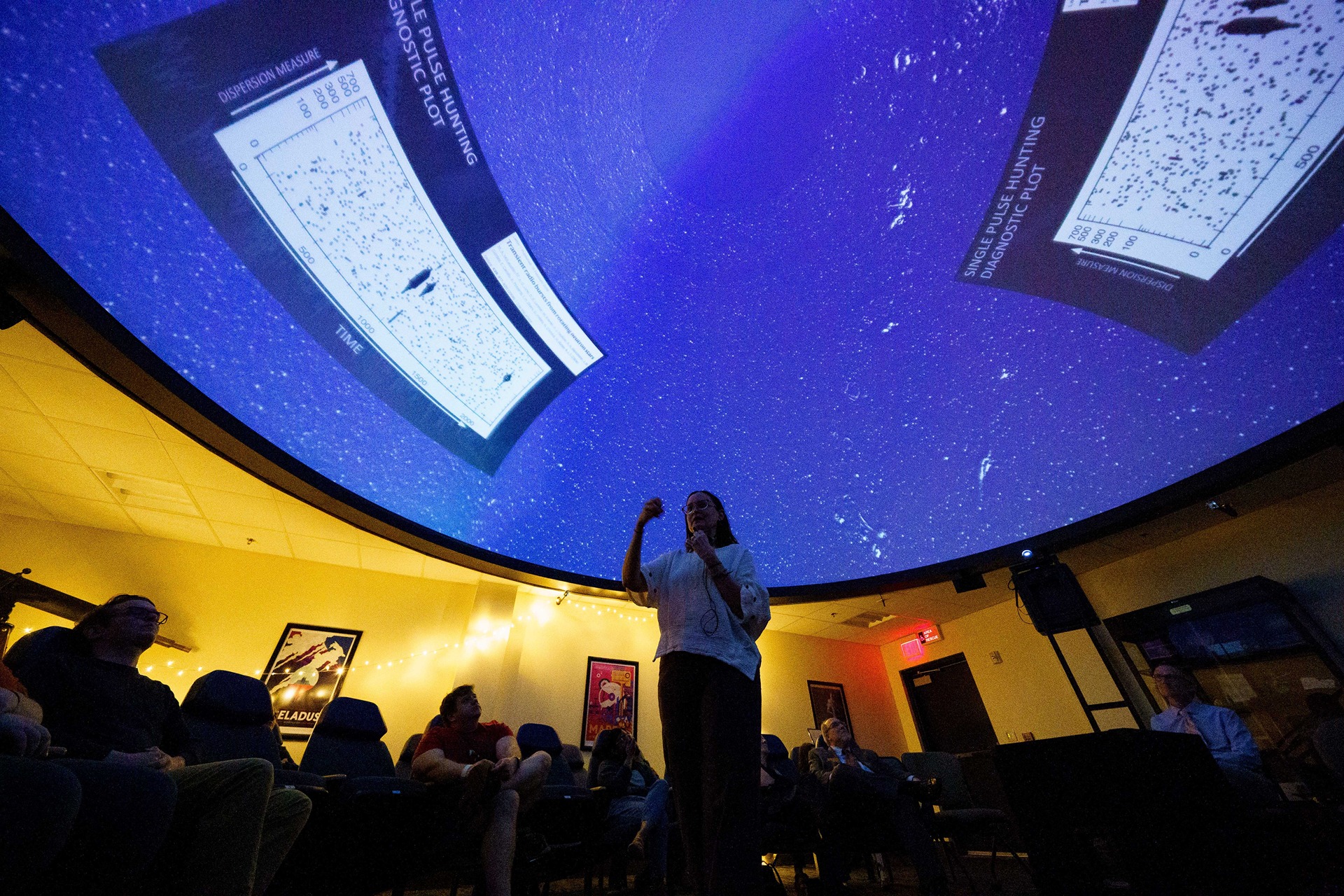
WVU Planetarium and Observatory
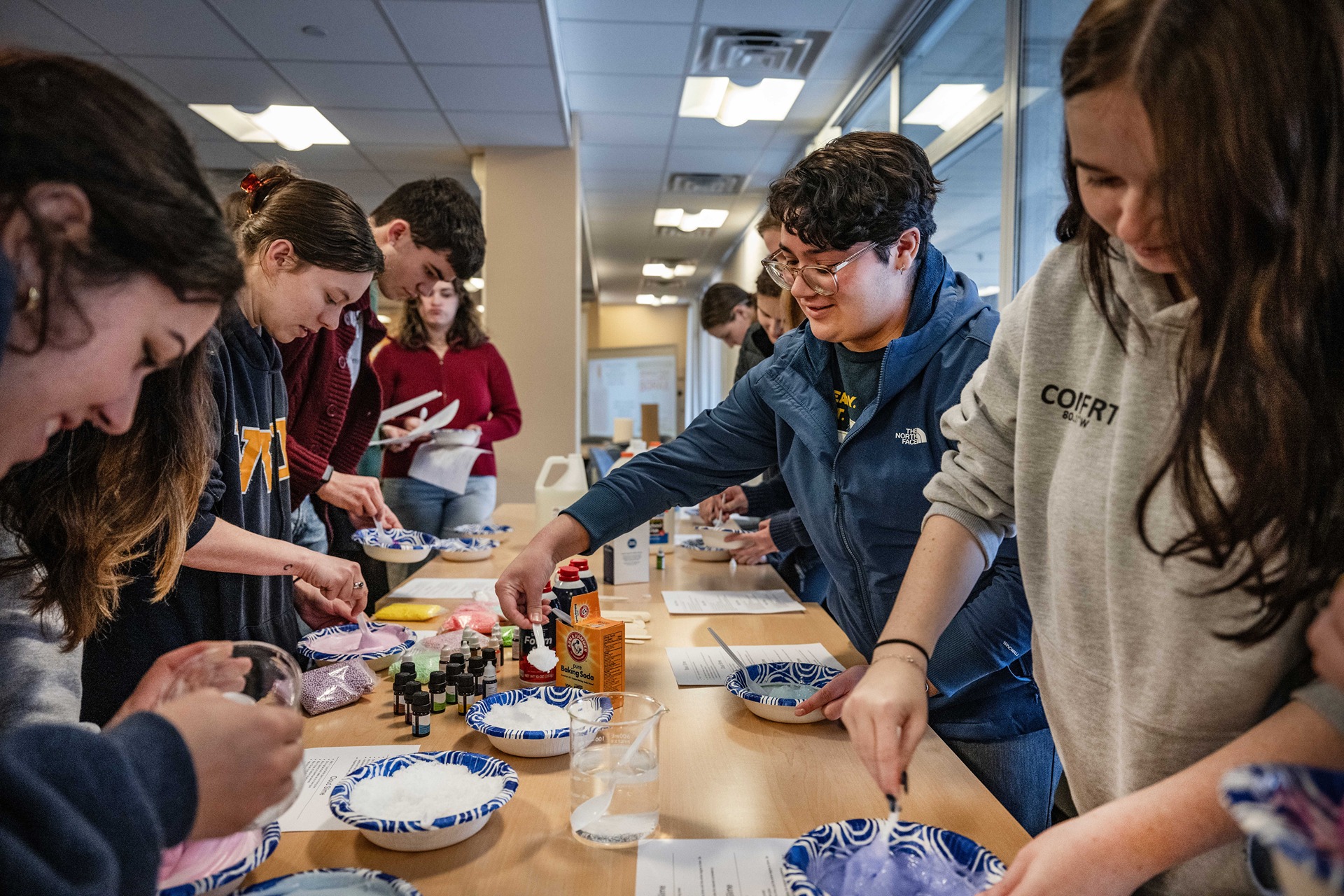
STEM Learning Center
Undergraduate Physics Lounge
Department of Physics and Astronomy Flexible Space
Virtual Tour
It’s the next best thing to being here. Virtually tour our campus and residence halls.
Student Life
You'll experience epic traditions, quality academics, and a supportive community that feels like home.
Visit
See WVU in person and start imagining life as a Mountaineer.
Admission Requirements
To be admitted to the Physics major, first-time freshmen must meet WVU's first-time freshman admission requirements. Interested in transferring? Review the transfer admission requirements.
Tuition and Aid
How much does Physics at WVU cost? And how can you save?
Tuition and Fees
Estimated rates are available on our tuition website. Anyone who is not a current West Virginia resident, including international students, will be charged non-resident rates.
Ways to Save
Beyond scholarships, here are other ways to reduce your cost of attending WVU.
Financial Aid
The most important step toward funding your future with financial aid for the Physics, BA/BS is submitting the Free Application for Federal Student Aid, or FAFSA.
Ohio Tuition Reciprocity
As the result of a special agreement, students from Ohio who are fully admitted to Physics can enroll at WVU and pay in-state tuition rates. Students must be admitted to both the University and this major.
Start at Another WVU Campus
You can start your career with WVU at another campus and transfer to WVU Morgantown.
Transfer Articulation Agreements
To simplify the transfer process, we have formal agreements with certain institutions. These agreements outline the courses you should take to prepare for transferring to WVU.
Review the full list of transfer articulation agreements to see if your institution is listed.
Request Info
Want to know more about Physics at WVU? Fill out our request form to receive more information.
Visit
Experiencing campus is the best way to see if WVU is the right fit. Choose from in-person and virtual options.