
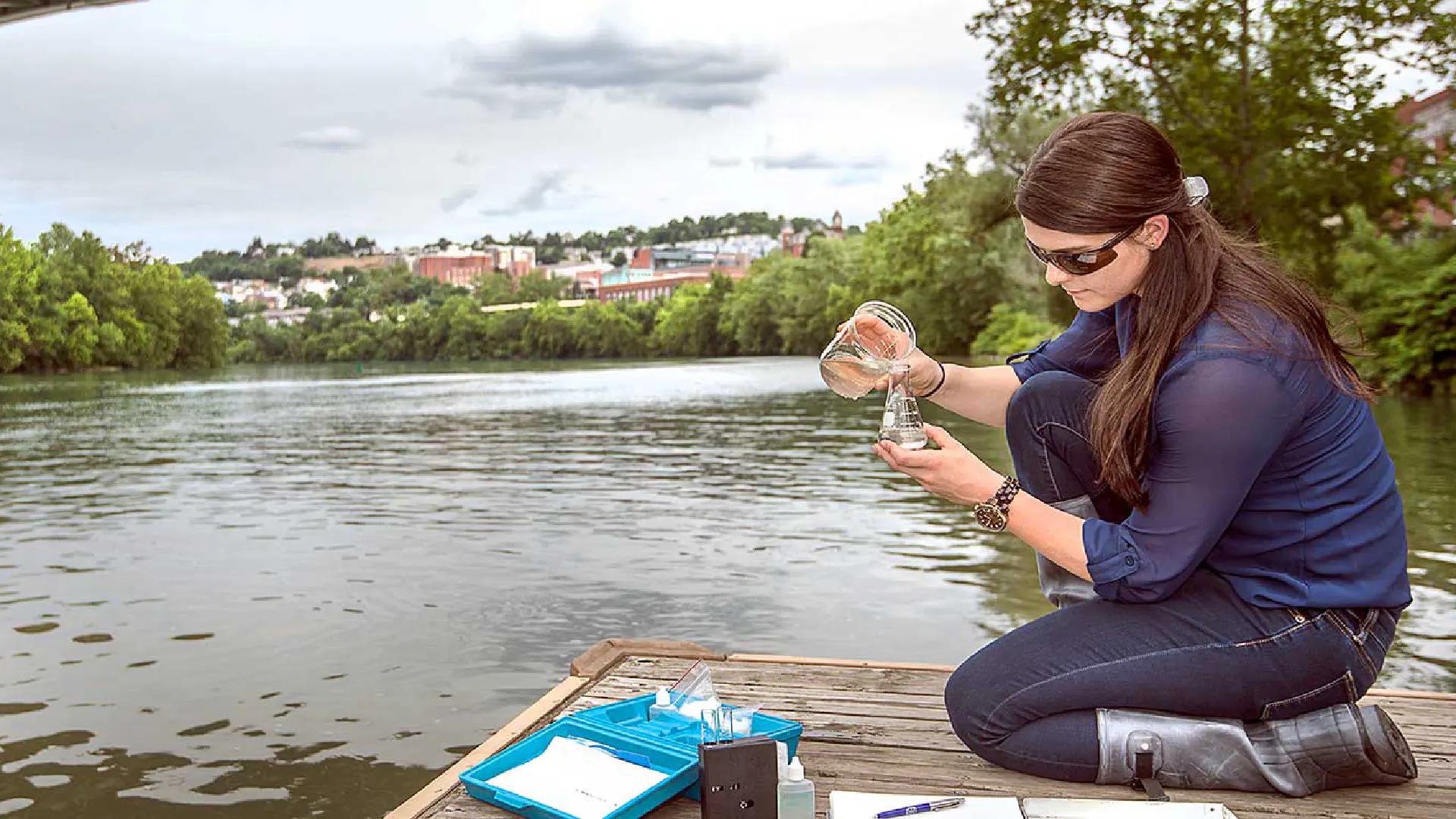
Environmental, Soil, and Water Sciences, BS
You can work with your adviser to select courses from both the environmental protection electives and the specialization electives that match your interests and career goals.
Recent graduates are employed by municipal, state and federal governmental agencies; consulting firms, especially those specializing in land reclamation, water quality, or pest management; and companies associated with natural resource industries.
Your Degree Plan
Reclamation of Disturbed Soils
AGRN 455
Principles of soil science, geology, hydrology, and engineering will be applied to surface mine planning, overburden handling during mining, soil replacement and amendments, revegetation practices, acid mine drainage control and treatment, hazardous wastes, and land management of disturbed areas. (Field trip required.)
Introductory Hydrogeology
GEOL 462
Basic principles of hydrogeology, emphasizing geologic occurrence of ground water, vadose (soil) water, wells, springs, ground water interaction with streams, and ground-water chemistry, pollution, and pollution restoration.
Environmental Policy
POLS 338
Explore the formulation and implementation of environmental policy, using both a policy process approach and policy analysis. Includes a discussion of the scientific, technological, risk, economic, and political variables which affect policy making in this area.
Foundations of Applied Geographic Information Systems
RESM 440
An introductory course designed to provide the necessary background and techniques to use GIS technology to analyze and solve spatial problems. An emphasis is placed on acquisition, management, and manipulation of spatial data.
Environmental Regulation
RESM 480
Course focusing on laws and policies applicable to the environment. Students will learn to read and interpret statutes, regulations and cases that impact water, air, toxic substances, land, and endangered species.
Freshwater Ecology
WMAN 446
Physical, chemical, and biological characteristics of inland waters with emphasis on the structure and function of stream ecosystems.
Stream Ecosystem Assessment
WMAN 449
Self-paced lectures and exercises culminating in a 1-week trip to the mountains of West Virginia for hands-on study of stream fishes, invertebrates, water and habitat quality, geomorphology, and ecology.
Environmental Sampling and Analysis
ENVP 355
Introduction to environmental sampling methods and analysis. Lecture and hands-on experience will include sampling plan development, sample point selection, sampling equipment use, containers and preservatives, sample analysis, chain-of-custody, and protective equipment.
Environmental Impact Assessment
ENVP 460
Application of physical, biological, and social science principles to assess environmental impacts. Review and prepare environmental assessments, permits, site assessments, and ecological risk assessments for environmental decision-making.
Environmental Assessment and Reclamation
Environmental Microbiology
Soil and Water Sciences
Honors
Expand your curiosity and enhance your curriculum through the WVU Honors College. Two programs are offered: Honors Foundations and Honors in Action.
The WVU Difference
What sets this program apart?
- Learn from nationally recognized experts in the fields of mine reclamation and soil and water conservation.
- Learn in farms and forests, our Research, Education, and Outreach Centers, located throughout West Virginia.
- Work on 1 of the oldest and largest certified organic university farms in the U.S.
- Paid laboratory job opportunities provide valuable hands-on training.
- Small-school environment with all the resources of a large university. You’ll benefit from 1-on-1 faculty interactions and develop a close relationship with your faculty and peers.
Learn by Doing
Get involved outside the classroom.
- Society of Environmental Professionals
- WVU Chapter of Society of Conservation Biology
- WVU Sierra Student Coalition
- WVU Soils Team
View all of the student organizations you can join.
Careers and Outcomes
How does this degree prepare students for a career?
Hydrologists
May Require Graduate Degree
Median Salary: $92,060
Possible Job Titles: Groundwater Consultant, Hydrogeologist, Hydrologist, Research Hydrologist
Chief Sustainability Officers
Has a Bright Outlook
May Require Graduate Degree
Median Salary: $206,420
Possible Job Titles: Chief Sustainability Officer (CSO), Sustainability Director, Sustainability Manager, Sustainable Design Director
Compliance Managers
Has a Bright Outlook
Median Salary: $136,550
Possible Job Titles: Compliance Director, Compliance Manager, Environmental Manager, Environmental Program Manager
Environmental Scientists and Specialists, Including Health
Has a Bright Outlook
Median Salary: $80,060
Possible Job Titles: Environmental Programs Specialist, Environmental Protection Specialist, Environmental Scientist, Environmental Specialist
Climate Change Policy Analysts
Has a Bright Outlook
May Require Graduate Degree
Median Salary: $80,060
Possible Job Titles: Climate Analyst, Climate and Energy Program Associate, Environmental Policy Analyst, Policy Analyst
Environmental Restoration Planners
Has a Bright Outlook
May Require Graduate Degree
Median Salary: $80,060
Possible Job Titles: Coastal and Estuary Specialist, Habitat Restoration Specialist, Marine Habitat Resources Specialist, Restoration Ecologist
Industrial Ecologists
Has a Bright Outlook
May Require Graduate Degree
Median Salary: $80,060
Possible Job Titles: Ecologist, Environmental Consultant, Environmental Protection Agency Counselor, Research Scientist
Geoscientists
Has a Bright Outlook
May Require Graduate Degree
Median Salary: $99,240
Possible Job Titles: Geologist, Geophysicist, Geoscientist, Project Geologist
Environmental Economists
May Require Graduate Degree
Median Salary: $115,440
Possible Job Titles: Environmental Economist, Natural Resource Economist, Research Economist, Resource Economist
Occupational Health and Safety Specialists
Has a Bright Outlook
Median Salary: $83,910
Possible Job Titles: Industrial Hygiene Consultant, Industrial Hygienist, Safety Consultant, Safety Specialist
Admission Requirements
To be admitted to the Environmental, Soil, and Water Sciences major, first-time freshmen must meet WVU's first-time freshman admission requirements. Interested in transferring? Review the transfer admission requirements.
Tuition and Aid
How much does Environmental, Soil, and Water Sciences at WVU cost? And how can you save?
Tuition and Fees
Estimated rates are available on our tuition website. Anyone who is not a current West Virginia resident, including international students, will be charged non-resident rates.
Ways to Save
Beyond scholarships, here are other ways to reduce your cost of attending WVU.
Financial Aid
The most important step toward funding your future with financial aid for the Environmental, Soil, and Water Sciences, BS is submitting the Free Application for Federal Student Aid, or FAFSA.
Ohio Tuition Reciprocity
As the result of a special agreement, students from Ohio who are fully admitted to Environmental, Soil, and Water Sciences can enroll at WVU and pay in-state tuition rates. Students must be admitted to both the University and this major.
Start at Another WVU Campus
You can start your career with WVU at another campus and transfer to WVU Morgantown.
Transfer Articulation Agreements
To simplify the transfer process, we have formal agreements with certain institutions. These agreements outline the courses you should take to prepare for transferring to WVU.
Review the full list of transfer articulation agreements to see if your institution is listed.
Request Info
Want to know more about Environmental, Soil, and Water Sciences at WVU? Fill out our request form to receive more information.
Visit
Experiencing campus is the best way to see if WVU is the right fit. Choose from in-person and virtual options.